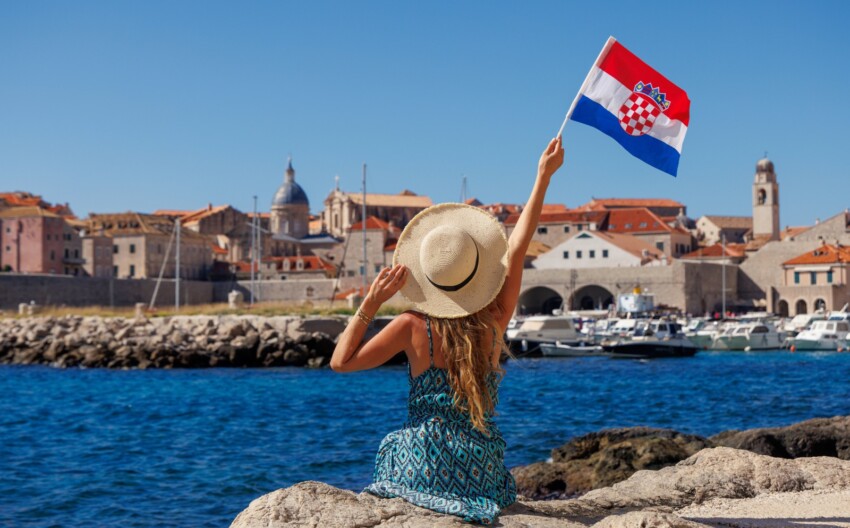
The Croatian flag is one of the country’s most recognisable and beloved national symbols, representing centuries of history, tradition and cultural identity. When you visit Croatia, you will notice this flag proudly flying on public buildings, monuments and during sporting events, where Croatian fans display it with particular passion.
The flag of the Republic of Croatia consists of a horizontal tricolour in red, white and blue, with the characteristic national coat of arms in the centre. This simple yet meaningful design encapsulates the soul of a nation that has gone through difficult times to gain its independence.
The current flag was officially adopted on 21 December 1990, some ten months before the proclamation of independence from Yugoslavia, marking a fundamental historical moment for the Croatian people. Since then, it has represented the sovereignty and national unity of Croatia.
The three colours of the Croatian flag are arranged in horizontal bands of equal size, from top to bottom: red, white and blue. These are the so-called panslavi colours, which also appear in the flags of other Eastern European Slavic states.
Each colour carries a deep symbolic meaning. Red represents the blood shed by Croats in the fight for freedom and independence over the centuries. White symbolises peace, unity and the purity of national ideals. Blue evokes the sky and the sea that wash the shores of Dalmatia and Istria, reflecting the country’s maritime vocation and high aspirations.
The ratio between the width and length of the flag is 1:2, in accordance with the specifications laid down in the Croatian Constitution. The colours combine the historical traditions of the Kingdom of Croatia (red and white), the Kingdom of Slavonia (white and blue) and the Kingdom of Dalmatia (red and blue), symbolically unifying the historical regions of the country.

The most distinctive and recognisable element of the Croatian flag is the centrally positioned national coat of arms, which slightly overhangs the upper and lower white bands. The coat of arms is dominated by the famous šahovnica (Croatian for ‘chessboard’), a red and white chequered motif that is one of the oldest symbols of Croatia.
The šahovnica consists of 13 red and 12 white (or silver in heraldry) squares, making a total of 25 squares arranged in five rows and five columns. The first square in the top left-hand corner is always red, a distinguishing feature of the Croatian coat of arms that has a precise historical and symbolic significance.
The origin of this chequered symbol is ancient and shrouded in various legends. Some stories trace it back to a legendary chess game between a Croatian hero and the Venetian doge, while other interpretations link it to Iranian traditions that would underline even more remote origins. The first documented evidence of the use of the chequered shield dates back to 1525, when Croatia, although it fell under Ottoman influence, retained its self-government and this symbol as a sign of national identity.
Above the šahovnica is a crown composed of five smaller shields, each representing one of the historical regions that make up modern Croatia. This crown was added in 1990 by academician and graphic artist Miroslav Šutej, author of the current design of the national coat of arms.
The five shields, proceeding from left to right, represent:
This heraldic composition perfectly represents the regional diversity and national unity of Croatia, reminding us that the country is the result of the union of territories with distinct but complementary histories and traditions.
The red-white-and-blue tricolour was first used in 1848 during the revolution led by the ban (governor) Josip Jelačić against the Hungarians. Since then, these colours have been associated with Croatian independence movements and national identity.
During the period when Croatia was part of theAustro-Hungarian Empire (until 1918), the flag continued to be used with various modifications. With the formation of the Kingdom of Yugoslavia in 1918, the Croatian flag underwent several transformations to adapt to the new political context.
During World War II, the Independent State of Croatia used a flag similar to the current one but without the crown and with the letter ‘U’ in the upper left corner, a reference to the Ustaša movement. The first square of the chessboard was white instead of red.
During the period of the Socialist Republic of Croatia, within communist Yugoslavia (1945-1990), the flag retained the red-white-blue tricolour, but instead of the coat of arms it had a five-pointed red star with a yellow border, the symbol of communism.
The modern flag was adopted in May 1990, immediately after the first multi-party elections that marked the end of the communist regime. The red star was replaced with the historical chequered coat of arms. The final design with the crown of five shields was officially approved on 21 December 1990, becoming a symbol of the reborn Croatian sovereignty.
The Croatian flag and coat of arms have an extraordinary importance in the collective imagination of the country. While in many Slavic nations, the colours of the flag are considered to be the main national symbol, in Croatia, this role falls mainly to the chequered coat of arms, the šahovnica, which is considered to be the true heart of national identity.
During sporting events, especially in football and basketball, Croatian fans proudly display the flag, creating spectacular choreographies. The chequered design is reproduced on T-shirts, scarves and gadgets, and has become instantly recognisable worldwide, especially after the national football team’s success at the World Cup.
Flag Day is celebrated on 21 December each year, the anniversary of its official adoption in 1990. On this date, public and private buildings display the national flag with particular solemnity.
 Hotel
Hotel  Budget accommodations
  Apartments
  Family Hotel
  Luxury Hotel
  Resorts