Bestseller
Split: Old Town and Diocletian Palace Walking Tour
From 14,99 €
Buy the ticket
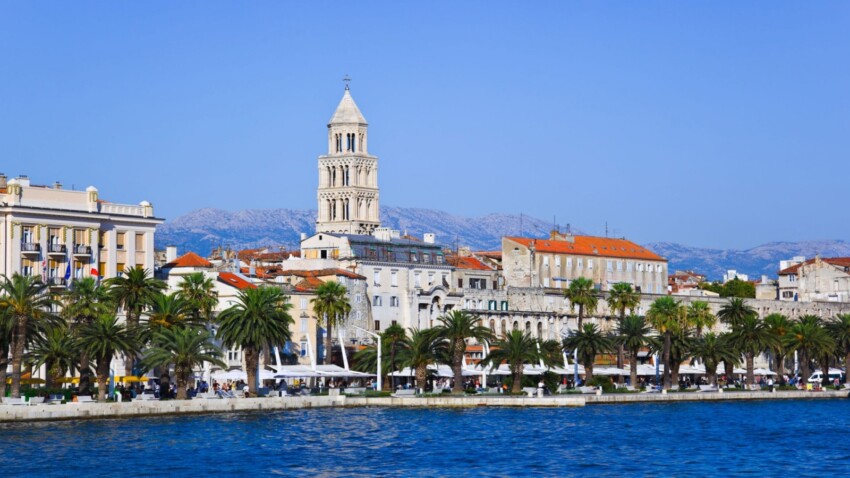
Diocletian’s Palace is one of the most extraordinary examples of Roman architecture in the world and forms the beating heart of Split. This imposing fortress-residence, built between 293 and 305 A.D., is not just a monument to be visited: it is a living city where some 3,000 people reside, a labyrinth of alleyways where bars, restaurants and shops occupy spaces that two thousand years ago housed the imperial halls and barracks of the Praetorian guard.
Inscribed on the UNESCO World Heritage List in 1979, the palace covers an area of over 30,000 square metres, enclosed by mighty walls up to 26 metres high. What makes this structure unique is its continuous evolution: from an imperial palace it became a refuge for refugees from nearby Salona in the 7th century, then a medieval town and finally the modern historical centre that today attracts millions of visitors every year. Walking through its alleys means passing through two thousand years of layered history, where Roman columns support modern flats and ancient crypts house trendy cafés.
The palace’s fame has grown further in recent years thanks to the TV series Game of Thrones, which used its dungeons and the Peristyle as a set for Meereen. However, long before the media phenomenon, the complex fascinated architects, historians and travellers alike with its exceptional preservation and its ability to blend the Roman past, medieval heritage and contemporary life in a perfect balance. To visit Diocletian’s Palace is not simply to admire ancient ruins, but to live an immersive experience in a unique urban organism.
The palace is divided into numerous spaces, each with its own history and distinctive characteristics. The ancient division between pars superior, reserved for the emperor, and pars inferior, for servants and military garrisons, is still recognisable in today’s structure. A full visit requires at least 2-3 hours, but you could easily spend a whole day exploring every nook and cranny of this extraordinary complex.
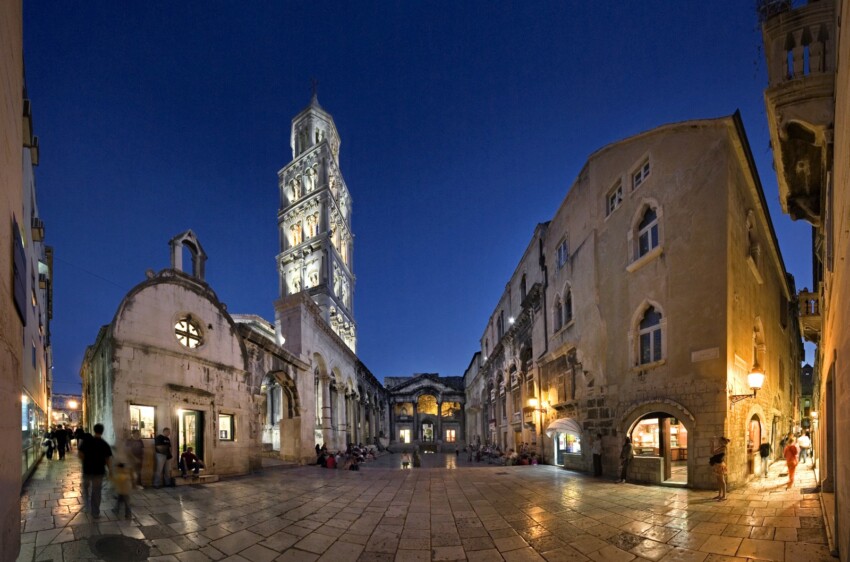
The Peristyle forms the centrepiece of the palace, the central square where the Emperor Diocletian appeared to his subjects on ceremonial occasions. Surrounded on three sides by an imposing red granite colonnade, this space retains its monumentality. The original flooring is still visible in some areas, while on the sides are arcades leading to the various rooms of the palace.
On the eastern side of the Peristyle is one of the twelve Egyptian sphinxes brought from Egypt by Diocletian, over 3,500 years old and perfectly preserved. This artefact represents the oldest object in Split. During the summer months, the Peristyle is transformed into a natural stage where concerts and performances are held, taking advantage of the exceptional acoustic qualities of the space. The square is surrounded by cafes with tourist prices, but the atmosphere at sunset, when the stones are tinged a warm honey colour and elongated shadows create plays of light, amply justifies a stop.
The Cathedral of St Doimus represents one of history’s most fascinating paradoxes: the building, originally constructed as the mausoleum of the emperor Diocletian, a notorious persecutor of Christians, was transformed in the 7th century into a cathedral dedicated to St Doimus, a martyred bishop executed by the emperor. The Christians removed Diocletian’s sarcophagus and placed the saint’s relics in it, thus completing a posthumous revenge full of symbolic meaning.
The building retains its original octagonal plan, bordered by 24 monolithic granite columns. Inside, you can admire the 13th-century Romanesque pulpit, the wooden Renaissance choir and the Baroque altars that overlap the austere Romanesque structure. Particularly valuable are the sculptural reliefs believed to depict the faces of Diocletian and his wife Prisca. On the second floor, the Cathedral Treasury houses relics, sacred vestments and illuminated manuscripts testifying to Split’s rich religious history.
The walls retain traces of ancient mosaic decoration and polychrome marble, while the coffered ceiling dates back to the medieval period. The underground crypt, accessible from the nave, reveals the remains of the original Roman foundations. The interior, despite the historical stratifications, maintains an architectural harmony that testifies to the quality of Roman design.
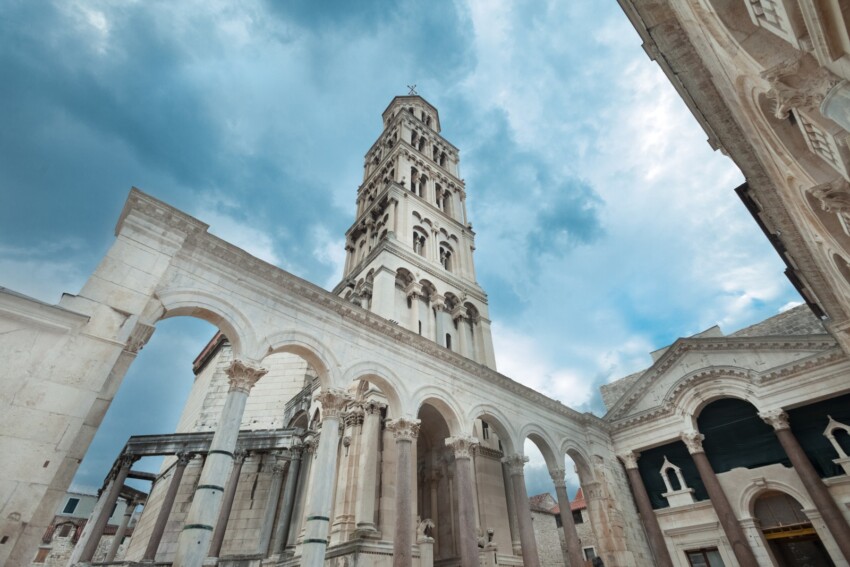
The San Doimo Bell Tower, built in Romanesque-Gothic style between the 12th and 16th centuries, soars 57 metres beside the cathedral. Climbing the 183 steps of the narrow spiral staircase requires some physical effort, but the reward is extraordinary: from the top there is a 360-degree panoramic view of Split, the port, the Dalmatian islands and the Mosor Mountains framing the city.
The bells of the bell tower still mark time in the city, as they have done for centuries. During the ascent, through the narrow slits in the walls, you can observe unusual perspectives over the roofs of the old town and the hidden courtyards of the palace. The best time for the climb is late afternoon, when the grazing light enhances the colours of the stone and the setting sun illuminates the islands on the horizon. Caution: the stairs are steep and smooth from wear and tear, so wear appropriate footwear and climb carefully.
The underground passages of Diocletian’s Palace constitute one of the best preserved ancient complexes of its kind. Their original function was twofold: to serve as a foundation for raising the imperial flats on the upper floor and to serve as storerooms and depots. The ground plan of the basement exactly replicates that of the flats above, allowing archaeologists to reconstruct the original appearance of the now vanished imperial halls.
The barrel vaults and the mighty columns supporting the upper structure create an evocative atmosphere, amplified by the soft light filtering through the openings. After centuries of use as a rubbish dump, the dungeons were cleaned and restored in the 1950s, revealing the refined architecture of the space. Today, they host temporary exhibitions and a permanent market of local handicrafts, although the latter is sometimes overcrowded with tourist stalls that weigh down the environment.
The fame of the dungeons grew exponentially after being used as a location for Game of Thrones, representing the underground halls where Daenerys Targaryen held her dragons captive. Themed tours dedicated to the series guide fans through the various locations, with particular emphasis on the palace dungeons.
The Vestibule is externally quadrangular but internally circular, surmounted by a dome originally decorated with mosaics. This space served as a monumental atrium leading to the emperor’s private flats, located in the southern part of the palace facing the sea.
The dome has lost part of its covering over the centuries, and today the opening at the top allows natural light to flood the space, creating striking effects depending on the time of day. The niches on the walls housed imperial statues, while the polychrome marble floor reflected the wealth of the court. The Vestibule provides access to the Ethnographic Museum and some of the city’s most prestigious hotels, housed in the former palatial rooms.
The building that today houses the Baptistery originated as the Temple of Jupiter, an integral part of the imperial religious complex. Its transformation into a Christian baptistery took place in the early Christian era, adding a further layer of significance to a space already steeped in history. In the 13th century, the baptismal font originally from the cathedral, a masterpiece of medieval sculpture, was placed here.
At the entrance you are greeted by another Egyptian sphinx, headless but still impressive in size and sculptural quality. The interior of the baptistery retains remnants of ancient and medieval decoration, with a coffered ceiling dating from the Christian conversion period. The small space of the building creates an intimate and cosy atmosphere, in stark contrast to the monumentality of the outer Peristyle.
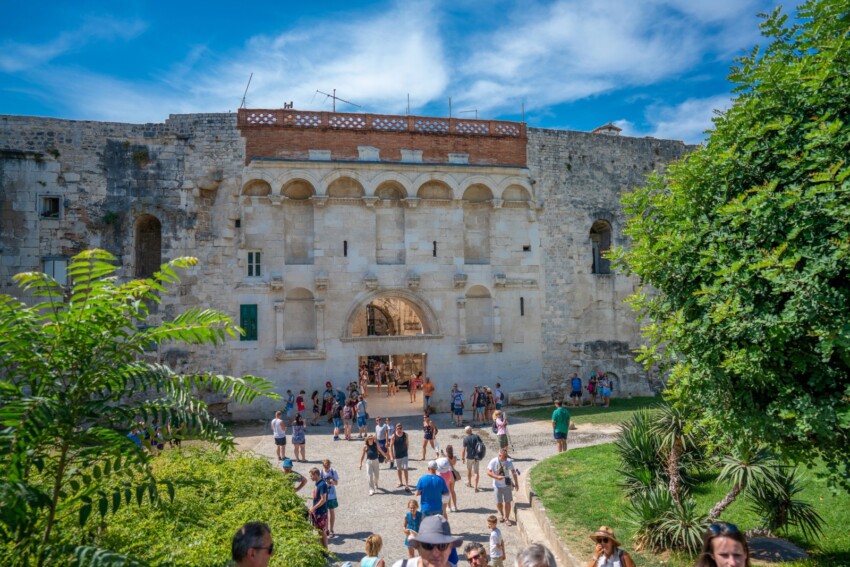
The palace is accessible through four monumental gates, each oriented towards a cardinal point and named after a precious metal. The Golden Gate (north) is the most imposing entrance, originally decorated with niches containing statues of the four tetrarchs. Today, outside the gate stands the monumental statue of Bishop Gregory of Nin, the work of sculptor Ivan Meštrović. Touching the statue’s polished big toe has become a tradition for visitors, believed to be a good luck charm.
The Argentea (eastern) Gate remained walled up from the Middle Ages until 1952, when it was reopened after the demolition of a Baroque church against the walls. Today, it is one of the main entrances for those arriving from the city market. The Iron Gate (west) is the only one through which life has flowed uninterruptedly for 1,700 years, connecting the palace with the old People’s Square (Pjaca). The passage still preserves the Renaissance clock whose bells mark the hours of the city.
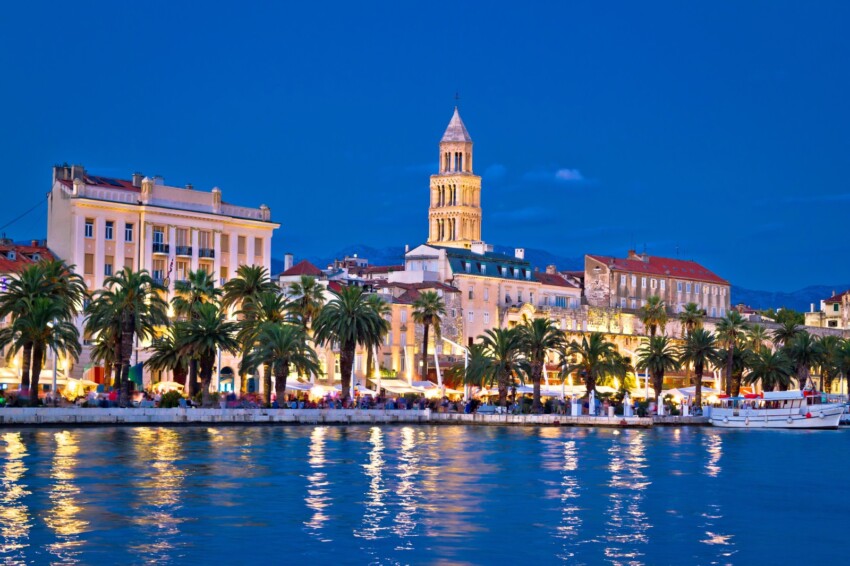
The Bronze (southern) Gate differs from the others in size and function: smaller and located directly on the sea, it provided the emperor with private access and an escape route in case of danger. Originally, the sea directly lapped the southern walls, whereas today the Riva, Split’s waterfront, separates the palace from the Adriatic.
One of the special features of Diocletian’s Palace is that access to the complex is completely free, as it is an integral part of the city of Split. You can freely walk through the four gates, stroll through the Peristyle and explore the alleys and courtyards without buying a ticket. This total openness distinguishes the palace from most archaeological sites and allows you to experience an ancient city that is still fully inhabited.
However, some specific attractions inside the palace require the purchase of tickets. The most convenient solution is the purple combination ticket that allows access to five sites: St Doimus Cathedral, Crypt, Baptistery (former Temple of Jupiter), Cathedral Treasury and Bell Tower. Partial tickets are also available for those who only wish to visit certain attractions: the blue ticket (Cathedral, Crypt, Baptistery), the green ticket (Cathedral, Bell Tower, Treasury) and the red ticket (Cathedral, Crypt, Baptistery, Treasury).
The palace basement requires a separate ticket. Tickets can be purchased directly at the sales points located in the Peristyle, with no advance booking required for individual entry. For guided tours, however, it is advisable to book in advance, especially during the peak summer season. Guided tours usually last 90 minutes and cost between 15 and 30 euro per person, depending on the type of tour and the sites included.
Diocletian’s Palace and other locations in Split were used extensively in the Game of Thrones series to represent the city of Meereen. The basement of the palace served as a set for scenes in which Daenerys Targaryen held her dragons captive, while the Peristyle and other areas of the palace appear in several scenes in seasons 4 and 5. This media exposure has significantly increased tourism in Split, and today many visitors come precisely to see the locations of the famous series in person.
For fans of the Game of Thrones series, specialised thematic tours are available that guide you through the locations used as sets. These tours, generally lasting two hours, include access to the dungeons and provide anecdotes about the filming, complete with set photographs and comparisons between TV fiction and historical reality. Some tours also offer the chance to wear costumes inspired by the series for souvenir photos.
Diocletian’s Palace does not have opening or closing times as it is the inhabited historical centre of Split. You can access the complex 24 hours a day, every day of the year. This freedom of access allows you to experience the palace at different times of the day, each with its own particular atmosphere.
The paid attractions inside the palace, on the other hand, follow specific timetables. During the high season (April-October), the Cathedral and the Bell Tower are generally open from 8 a.m. to 8 p.m., with possible variations in Sunday hours for religious services. The dungeons maintain similar hours, from 9 a.m. to 9 p.m. in summer. During the low season (November-March), hours are reduced, with closures often scheduled around 5-6pm. On Mondays, some sites may have reduced hours.
For a complete tour of the palace and its main attractions, allow at least 2-3 hours. If you wish to explore at your leisure, visit related museums such as the City Museum in the Papalić Palace, and take a break in one of the characteristic cafés, dedicate half a day. History and architecture enthusiasts could easily spend a whole day in the complex.
Avoid the middle of the day in high season (July-August), when cruises pour in thousands of tourists at once, making it difficult to even walk around the Peristyle. As for the time of year, May, June, September and October are ideal: pleasant climate, less crowding and lower rates than in high season.
Diocletian ‘s Palace is located in the heart of Split, perfectly connected by all means of transport. Once you reach the centre, getting your bearings is easy: the palace dominates the waterfront and the four gates are clearly visible. The Bronze Gate (south) opens directly from the Riva, the waterfront, and is the most scenic access. If you are travelling by public transport or arriving from the bus station, you will probably enter through the Iron Gate (west) via Piazza del Popolo.
Emperor Gaius Aurelius Valerius Diocletian was born in 244 A.D. in Salona (today’s Solin), a few kilometres from where his palace would be built. Of humble origins, he pursued an extraordinary military career until he was proclaimed emperor in 284 AD. During his reign he implemented radical reforms that redesigned the structure of the Roman Empire, introducing the system of the tetrarchy: the division of power between four rulers (two Augusti and two Caesars) for more effective management of the vast imperial territories.
Construction of the palace probably began in 293 A.D., after the victorious Egyptian campaign that provided Diocletian with both the sphinxes that would adorn the residence and the prestige needed for a project of such ambition. The building site employed skilled labour from all over the empire: Greek architects, Egyptian stonemasons, Italic masons. Materials came from quarries scattered around the Mediterranean: Carrara marble from Italy, red granite from Egypt, and above all the beautiful white stone extracted from theisland of Brač, which still characterises the architectural landscape of Split today.
In 305 A.D., tried by illness and tired of power struggles, Diocletian made an unprecedented gesture in Roman history: he voluntarily abdicated. He was the first and only emperor to do so by personal choice, retiring to his newly completed palace. Here he spent the last eight years of his life devoting himself, according to ancient sources, to growing vegetables in the palatine gardens and to philosophical reflection, refusing all requests to return to power. He died in 313 A.D. and was buried in the mausoleum that has now become a cathedral.
After the emperor’s death, the palace remained imperial property for a few decades, but the importance of Salona as the capital of Roman Dalmatia gradually relegated the structure to a marginal role. The fate of the palace changed dramatically in A.D. 614, when hordes of Avars and Slavs destroyed Salona. The survivors sought refuge in the mighty walls of the abandoned palace, turning it into a fortified city. Imperial spaces were subdivided into dwellings, temples converted into churches, corridors into streets. This metamorphosis saved the palace from complete destruction and allowed it to evolve into a living urban organism.
During the Middle Ages, the palace-city saw the rise of Romanesque churches, Gothic noble palaces and Venetian fortifications superimposed on Roman structures. The Renaissance and Baroque added further architectural layers, creating the building palimpsest that makes the complex so fascinating today. In the 18th century, the Scottish architect Robert Adam made the first scientific surveys of the palace, publishing a volume in 1764 that profoundly influenced European and American Neoclassicism.
The 1979 UNESCO recognition emphasised the need to protect this unique heritage, where Roman architecture, 12th-13th century early Christian and Romanesque churches, medieval fortifications, 15th century Gothic palaces and Renaissance and Baroque residences coexist. Today, the palace represents not only an archaeological monument of primary importance, but also a successful example of conservation through continued use, demonstrating that the best way to protect a historical building may be precisely to keep it alive and inhabited.

 Hotel
Hotel  Budget accommodations
  Apartments
  Family Hotel
  Luxury Hotel
  Resorts